For patients, this can mean fewer trips to the GP surgery, easier management of repeat medicines and greater flexibility over where prescriptions are dispensed. But what actually happens after your doctor issues an electronic prescription? And do you need to choose a particular pharmacy?
This guide explains how EPS works, what pharmacy nomination means and what patients should know about electronic prescriptions.
What Is the NHS Electronic Prescription Service?
The Electronic Prescription Service, usually shortened to EPS, is an NHS service that enables prescriptions to be sent electronically from a prescriber to a dispenser, such as a community pharmacy.
Instead of relying on a traditional paper prescription to carry prescribing information between the two organisations, EPS securely transfers the relevant information electronically.
NHS England describes EPS as a service designed to make prescribing and dispensing more efficient and convenient for both patients and healthcare professionals. It is widely used in primary care and is also available in other healthcare settings.
It is important to understand that EPS itself is not a clinical prescribing system. Your doctor or another authorised healthcare professional still decides whether a medicine is appropriate and creates the prescription through their clinical system. EPS manages the electronic workflow that allows that prescription to reach the dispenser.
How Does EPS Work?
For patients, the process can appear simple: a prescription is issued and the pharmacy receives it electronically. Behind the scenes, several secure NHS systems are involved.
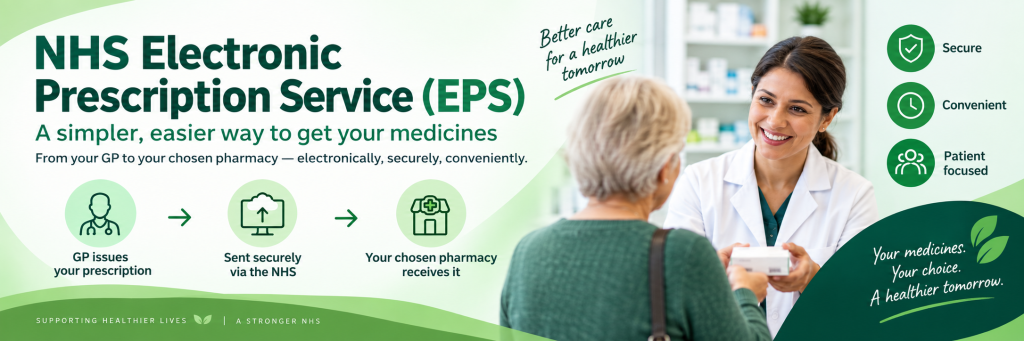
Here is how the process generally works.
Step 1: A Prescriber Creates Your Prescription
Your GP or another authorised prescriber assesses your healthcare needs and, where appropriate, issues a prescription.
The prescription is created through an approved prescribing system. EPS can support prescriptions following face-to-face appointments as well as telephone or video consultations where clinically appropriate.
This is particularly useful because patients do not necessarily need to return to the GP surgery simply to collect a paper prescription.
Step 2: The Prescription Is Digitally Signed
Electronic prescriptions are digitally signed by an authorised prescriber.
The prescription information can include the medicine or appliance prescribed, instructions for the patient and pharmacy, information about the prescriber and relevant patient details.
The digital prescription is then securely transmitted through NHS infrastructure.
Step 3: The Prescription Is Sent to the NHS Spine
EPS securely transfers prescription information through the NHS Spine, the national infrastructure that supports communication between authorised health and care systems in England.
Information sent through EPS can include:
- your NHS number, name, date of birth and address;
- your nominated pharmacy, where applicable;
- your registered GP practice;
- the medicine or appliance prescribed;
- prescribing and dispensing instructions;
- information identifying the prescriber; and
- the advanced electronic signature attached to the prescription.
The electronic prescription is then available for an authorised dispensing system to retrieve.
Step 4: Your Pharmacy Retrieves the Prescription
If you have nominated a pharmacy, your prescription can normally be sent electronically to that dispenser.
The pharmacy’s authorised system retrieves the electronic prescription from the NHS Spine. Pharmacy staff can then process it, carry out the necessary professional and clinical checks, prepare the medicine and dispense it when appropriate.
EPS enables dispensers to perform several electronic actions, including releasing and verifying prescriptions, sending dispensing notifications and submitting dispensing claims.
Step 5: You Receive Your Medicine
Once the prescription has been processed and the medicine is available, you can obtain it according to the pharmacy’s normal collection or delivery arrangements.
EPS changes how the prescription information travels. It does not mean that every medicine will automatically be ready immediately after your GP issues it.
A pharmacy may still need time to process the prescription, complete appropriate checks and obtain stock.
What Is an EPS Pharmacy Nomination?
One of the most useful features of EPS is nomination.
A nomination is your choice of the dispenser that should normally receive your electronic prescriptions. For most people, this will be the community or internet pharmacy they regularly use.
NHS England’s current standards state that patients can have up to three types of nomination: one pharmacy, one dispensing appliance contractor and, where applicable, one dispensing doctor.
For example, if you regularly use the same local pharmacy, you can nominate that pharmacy. When an eligible electronic prescription is issued, it can then be sent there without you having to carry a paper prescription from your GP.
Nomination can be particularly convenient for people receiving regular repeat prescriptions.
Can I Change My Nominated Pharmacy?
Yes.
Your nomination is your choice, and you are not permanently tied to one pharmacy.
You can ask for your nominated pharmacy to be changed or removed. NHS England states that patients can change or cancel their choice of dispenser by speaking to their GP or pharmacist before ordering their next prescription.
Patients can also manage their nominated pharmacy through supported NHS App functionality.
Importantly, pharmacies and other organisations should not pressure patients into selecting a particular dispenser. NHS England’s EPS nomination standards state that patients must not be influenced or persuaded to nominate a specific dispensing contractor, and inducements must not be offered to obtain a nomination.
What If I Do Not Have a Nominated Pharmacy?
Having a nomination is convenient, but EPS can also support prescriptions where a pharmacy has not been nominated.
Under EPS Phase 4, prescriptions can be signed, sent and processed electronically without a pharmacy nomination.
In these circumstances, a patient may receive a token containing a unique barcode. A pharmacy can use the barcode to retrieve the electronic prescription from the NHS Spine.
This gives patients additional flexibility where they do not routinely use the same pharmacy or need to use an alternative dispenser.
What Is an EPS Prescription Token?
Although EPS is electronic, you may occasionally encounter a piece of paper associated with your prescription.
This is generally a token, rather than the legal electronic prescription itself.
NHS England describes prescribing and dispensing tokens as paper copies containing information from electronic prescriptions. Tokens are used in certain circumstances to support the electronic dispensing process.
For example, a token containing a barcode can help a pharmacy retrieve a non-nominated electronic prescription.
The important distinction is that the prescription itself exists electronically within the EPS workflow; the token helps identify or support access to it.
Can I See My Electronic Prescription in the NHS App?
The NHS has expanded patient access to prescription information through the NHS App.
Eligible NHS App users can access digital prescription information, and NHS England has introduced national prescription tracking functionality that connects information from EPS and pharmacy dispensing systems.
This can allow patients to see information about their prescriptions and, where supported, check their status or readiness.
A digital prescription can also include a barcode that can be presented to a dispenser on a smartphone in appropriate circumstances.
However, the information displayed can depend on the prescription, pharmacy system and stage of processing.
Can an EPS Prescription Be Tracked?
Yes. Prescription tracking is an important part of EPS.
Healthcare professionals at authorised prescribing and dispensing sites can use the EPS prescription tracker to check the status and location of an electronic prescription.
This can help determine whether a prescription exists, whether it has reached the NHS Spine, whether a dispenser has downloaded it and its progress through the prescribing and dispensing process.
Patients can also access supported prescription tracking information through the NHS App.
If you believe your prescription has been issued but your pharmacy cannot locate it, contacting your GP practice or pharmacy can therefore help establish what has happened.
What Are the Benefits of EPS for Patients?
EPS was designed to make the prescription process more convenient and efficient.
One of its main benefits is that patients receiving repeat medicines may no longer need to visit their GP practice simply to collect a paper prescription. The prescription can instead be transferred electronically to the nominated pharmacy.
EPS may also offer:
Greater convenience: prescriptions can be sent electronically following appropriate consultations.
Less paperwork: electronic transmission reduces dependence on traditional paper prescription forms.
Easier repeat prescription management: patients regularly using the same pharmacy can have eligible prescriptions sent directly there.
More flexibility: nomination can be changed, and EPS Phase 4 supports electronic prescriptions without a permanent pharmacy nomination.
Prescription tracking: supported NHS systems allow patients and authorised healthcare professionals to check prescription status.
Improved dispensing efficiency: pharmacies receive structured electronic prescription information, reducing the need to manually enter some prescription details.
Is the Electronic Prescription Service Secure?
EPS is part of NHS digital infrastructure and is designed to transfer prescription information securely between authorised healthcare systems.
Electronic prescription information is transferred through the NHS Spine. Access to relevant systems is restricted, and healthcare professionals connecting to NHS Spine services require appropriate permissions.
NHS England is the data controller for EPS and publishes information explaining what data is processed, why it is required and how the service operates under data protection requirements.
Patients should still protect their NHS App account and personal information in the same way they would other sensitive healthcare information.
Does EPS Work for Repeat Prescriptions?
Yes. Repeat prescriptions are one of the areas where EPS can be especially convenient.
If you regularly receive the same medication and have nominated a pharmacy, eligible repeat prescriptions can be transmitted electronically rather than requiring you to collect the prescription from the GP practice.
There is also a related NHS process called electronic Repeat Dispensing (eRD). This allows an authorised prescriber, when clinically appropriate, to issue a series of repeat prescriptions electronically for dispensing at specified intervals.
EPS and eRD are related but are not the same thing: EPS provides the electronic prescription infrastructure, while eRD is a method for managing suitable repeat medication.
What Should I Do If My Pharmacy Cannot Find My Prescription?
If your pharmacy says it cannot locate an expected prescription, first check whether your GP or prescriber has actually issued it.
You should also confirm which pharmacy is currently nominated, particularly if you have recently changed pharmacies.
If necessary, pharmacy or GP practice staff may be able to use NHS prescription tracking tools to establish the prescription’s status or location.
Avoid requesting a duplicate prescription immediately unless your prescriber advises you to do so, as the original electronic prescription may still be active elsewhere in the system.
Frequently Asked Questions
Do I have to use EPS?
Electronic prescribing is now the standard route for the great majority of prescriptions in England, although paper prescriptions may still be used in particular circumstances. NHS England reports that more than 95% of prescriptions in England are produced electronically.
Can I choose which pharmacy receives my prescription?
Yes. EPS nomination allows you to choose a pharmacy, including a specific community or internet pharmacy, to receive your electronic prescriptions.
Can I change my nominated pharmacy?
Yes. Your nomination can be changed or cancelled. It is best to make the change before ordering your next prescription.
Is EPS the same as the NHS App?
No. EPS is the infrastructure used to transfer electronic prescriptions. The NHS App is a patient-facing service that can provide access to prescription information and features such as managing a nominated pharmacy and supported prescription tracking.
Can I track my NHS prescription?
Yes. NHS England provides prescription tracking functionality for patients through the NHS App, while authorised healthcare professionals have access to EPS tracking tools.
Final Thoughts
The NHS Electronic Prescription Service has changed the way prescriptions move between prescribers and pharmacies in England. Instead of depending mainly on paper forms, EPS allows prescription information to be transmitted securely through NHS systems to an appropriate dispenser.
For patients, the result can be a simpler process: a GP or other authorised prescriber issues the prescription, it is transmitted electronically, and the pharmacy retrieves it for dispensing. Patients who regularly use the same pharmacy can nominate it to receive their prescriptions, while NHS App functionality provides additional ways to manage nominations and access prescription information.
EPS does not replace the professional responsibilities of doctors, pharmacists or other healthcare professionals. Nor does an electronic prescription guarantee that a medicine is immediately available. What it does is provide secure digital infrastructure that can make prescribing and dispensing more efficient, traceable and convenient.
For official information, patients can consult the NHS England Electronic Prescription Service guidance or speak to their GP practice or pharmacist.
This article is for general information only and does not replace advice from a GP, pharmacist or other qualified healthcare professional.